Riverturn Summer
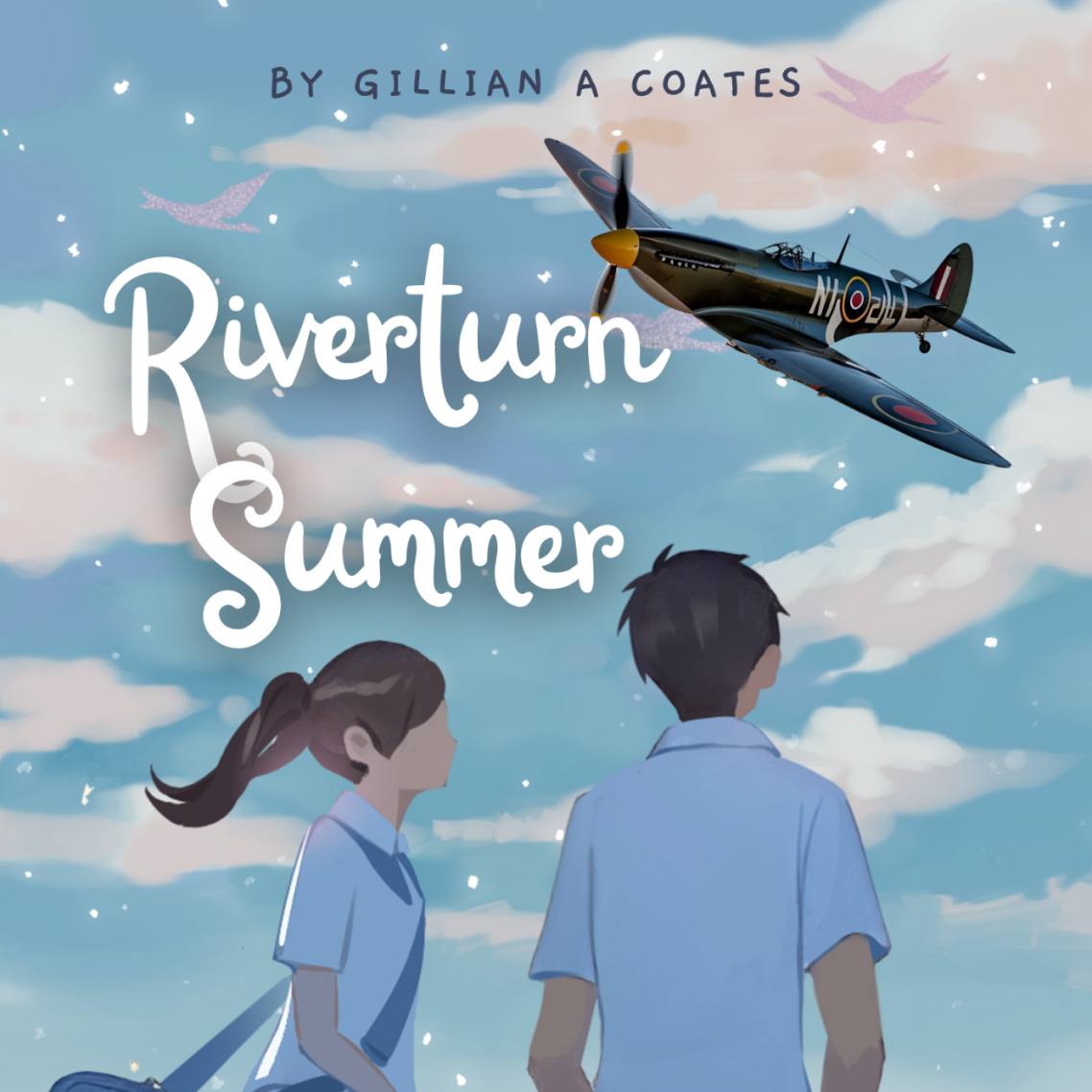
Maggie Dean (11) and her brother Laurie (7) move with their family to a new home, Riverturn, at the start of World War II. As the year 1940 unfolds the trials in Maggie’s own life echo the turmoil in the world around her, including the Battle of Britain being waged above her head. When she encounters a downed German pilot by chance, Maggie makes a momentous decision that threatens not just her life, but Laurie’s too.
A coming-of-age story set in WW2, Riverturn Summer is suitable for readers aged 11 upwards. There is mild swearing on several occasions.
A review of Riverturn Summer
By Lovereading4kids
“An emotive and thought provoking read following an 11 year-old’s experience of life during World War II Britain.”
“11 Year old Maggie Dean moves with her family from Gloucestershire just before Christmas 1939 to a house called Riverturn on the Thames near London. We see through Maggie’s eyes as the war encroaches on their lives more and more, while she also faces the day-to-day challenges of settling into a new school, friendships and growing up.
Much like her Mill on the Floss namesake Maggie is a complex character. I really felt for her at times throughout the story where she got into trouble, especially when it seemed the adults around her weren’t really listening to her. It made me sad to read as her family and teacher’s dismissive attitudes left her feeling so alone. Amongst the darker themes and the obstacles Maggie faces there were some lighter moments that made me laugh. Her crush on Peter was sweet, her friendship with Pip and close relationship with her brother Laurie brought light to the story.
The movie reviews throughout brings more of Maggie’s character to life while also providing more detail to the historical backdrop of the tale. The narrative feels authentic and well-researched, confirmed by the inclusion of more detail about the references made in each chapter and the authors note at the end about their inspiration for particular elements of the story.
Riverturn Summer is an emotive read, I felt Maggie’s overwhelm and frustration. Also the storyline doesn’t shy away from the sadder, darker moments of war, which led to a few heartbreaking scenes.
Riverturn Summer is an interesting historical fiction that explores World War II from the perspective of an 11-year old Maggie. As such, while the war features prominently there is still more of a focus on Maggie’s life and what impacts it.”
(This is an extract. The full version appears on Lovereading4kids website.)
An excerpt from Riverturn Summer
In which Maggie and her friend Pip decide to try to cheer up Pip’s mother….
The government had just announced that from now on it would be a criminal offence to cause alarm or despondency. Maggie saw this as her big opportunity. She recognised at once how hard it was for grown-ups like her parents, Enid Pearce and the Gibsons not to be despondent when they had no idea where their loved ones were, or even if they were still alive. Even Pip was not as cheerful as she used to be. Everyone was having to make compromises, living on increasingly small rations and worrying about the threat of an imminent attack. Children in London were leaving their families and being evacuated to the countryside or to the Dominions (Maggie had no idea where the Dominions were, but they sounded very far away. Probably near the Dardanelles.) But for them to be branded as criminals was unthinkable to her. She decided her new mission was to save everyone she knew from falling into the trap of despondency. From now on she would be a model of cheerfulness. Not only would she do her good deed every day but she would bring sunshine wherever she went.
Her first opportunity came on Saturday morning when she spotted something in the newspaper and ran straight round to Pip’s.
“I’ve thought of a way to cheer your mum up.”
Pip was still in her pyjamas. She yawned.
“How?”
“Well, you know ladies aren’t supposed to buy luxuries any more?” Pip nodded. She could not think of a time when her mother bought luxuries anyway, but she listened. “There’s a recipe for Creme Tokalon in the newspaper this morning. I thought we could make her some.”
Creme Tokalon was an expensive face cream, supposed to give you younger looking skin. Pip’s interest was piqued. She took the newspaper Maggie proffered and read the advert, then she screwed up her face.
“It’s not exactly a recipe, is it?”
“Well, it’s near enough. I’m sure we can give it a go.”
“What is pre-digested pure cream of milk, do you think?”
“Just cream, I imagine.”
“What about these ‘other valuable, tonic and nourishing ingredients’? It’s not very specific.”
“I’m sure we’ll find something. Look, are you going to help or not?”
“Alright.”
Pip went upstairs to change out of her pyjamas. Maggie called up to her as she went:
“Bring your bike and meet me at mine in twenty minutes.”
When Pip arrived they cycled over to Gibson’s Farm to ask Vi for some cream.
“How much do you need, dears?”
“Well, the recipe says an ounce, but that’s for one and I suppose we ought to do some for Mummy as well. Could you spare two ounces?”
“Of course, dearie.”
Pip asked the essential question.
“Aunty Vi, your cream doesn’t happen to be pre-digested, does it?”
“Goodness me! I’ve never heard of that. I don’t think so, no. It just comes straight from the cow. I suppose they’ve digested grass to make it. Is that what you mean?”
“Probably. It’s not important.”
Vi went off to the kitchen and came back with a small bottle half-filled with cream, which she handed to Maggie.
“I’ve put a bit extra in there so your little brother can have some in his tea. Keep his strength up.”
“Thanks Aunty Vi.”
Back at Riverturn they went into the kitchen and started work. Maggie found a bowl and poured most of the cream into it.
“Steady on. It says an ounce” warned Pip.
“Well, that’s about right. I’ve left a bit in the bottle for Laurie. Don’t forget we are making two. It’s a bit runny though. I think we should whisk it.”
It took longer than they expected to work the cream and they had to take turns when their arms got stiff, but eventually it became satisfyingly thick.
“Now what?” asked Maggie.
Pip checked the advert.
“An ounce of pure olive oil. Do you have any, do you think?”
“Let’s see what Mummy’s got in the larder.”
The only oil was ordinary cooking oil which seemed a little mundane for luxury face cream.
“What about dripping?” ventured Maggie, half joking.
“Urgh, no. That’s made from beef fat. I don’t think Mummy would want that in a face cream.”
“Butter, then? How much did you say we need?”
“An ounce.”
Maggie chewed her lip.
“That’s two ounces, a whole week’s ration for someone. I don’t think we can spare that. Let’s look in the bathroom.”
The bathroom cabinet yielded a bottle of Cod Liver Oil. Maggie read the label then opened it and sniffed it.
“Urgh! It’s a bit fishy, but the label says it is very good for you. It seems to cure practically everything. Shall we use this instead?”
Pip shrugged.
“It’s got to be better than dripping.”
The cod liver oil went in. The mixture curdled at first but with some vigorous beating it was soon blended in. This was going well, but they had not yet added any ‘nourishing ingredients’. Maggie looked in the bathroom cupboard again and rifled through the various packages, tossing them to Pip.
“This one looks good,” said Pip. She held up a packet of Phyllosan tablets whose packaging promised to ‘rejuvenate and revitalise’. This was exactly what they wanted.
“How much does it say we need?”
Pip consulted the newspaper advert again.
“It just says ‘scientific proportions’.”
Maggie shrugged. Neither of them were scientists.
Back in the kitchen, Pip took out four of the Phyllosan tablets, crushed them into a powder with the back of a spoon and added them to the bowl.
“That’s scientific proportions. Two for each pot,” she said.
“It’s still a bit runny,” complained Maggie. “How about some flour? That thickens things.”
“It’s not very ‘nourishing’.”
“Well, you use it in pastry, that’s nourishing.”
Pip decided not to argue, so a teaspoon of flour went in. Maggie stirred vigorously and the mixture actually began to look quite convincing.
“What shall we call it?” Maggie asked. “We can’t call it Creme Tokalon ‘cos it’s our own invention really.”
“How about, Creme Phileeepa-Margareeta?” suggested Pip. She elongated the vowels in their names to make them sound more exotic.
“I love it.”
“We’ll need some nice jars to put it in.”
They put the bowl on the cold slab in the larder and went off to see what they could find.
*
Bill came in from the garden with a trug full of pickings from his vegetable patch. He had a lettuce, some broad beans and the year’s first strawberries. He was very proud of his patch. He had worked hard in the spring to get the ground ready and had been watering it regularly since. The first fruits of his labour had now started to show and he was looking forward to a good crop of potatoes, tomatoes, lettuces, runner beans, onions and cabbages, as well as strawberries and raspberries for jam and apples and plums off the trees.
He put the trug in the larder to keep it cool and noticed the bowl of thick cream on the cold slab. Unable to resist and knowing he was alone, he picked one of the biggest, ripest strawberries off the pile, dipped it into the bowl of cream and popped it in his mouth. It tasted disgusting: greasy, gritty and vaguely fishy. He swallowed it quickly with a small shudder of disgust then he picked up the bowl and carried it through to the sitting room where Ivy was sitting with Laurie, practicing his reading.
“Ivy dear, this cream’s off.” He spoke rather indignantly.
“I don’t know what you mean, dear. I haven’t got any cream.”
“Well, what’s this then?” He thrust the bowl under her nose and she sniffed it.
“Good grief! I’ve no idea. Maggie and Pip have been in the kitchen, you’d better ask them. I think they went upstairs.”
The girls were searching the house for small receptacles for their invention. Maggie had borrowed a small cut-glass trinket box from Ivy’s dressing table and a near-empty blue glass jar of Vicks vapour-rub which she thought she could persuade Ivy to scrape clean. They heard Bill calling for them and they went downstairs. He was standing in the sitting room looking mystified with their bowl in his hand.
“Maggie, what’s in this bowl?”
“It’s Creme Phileeepa-Margareeta” announced Maggie proudly.
“Creme Phileeepa-Margareeta?” Bill could barely disguise the wry amusement in his voice. “And what is that?”
“It’s a face cream for younger looking skin.”
“You’re eleven. Why would you want your skin to look any younger?”
“It’s not for me, silly. We made it for Pip’s mum, to stop her feeling despondent so she won’t go to prison.”
“I’m sure Enid is not in any danger of going to prison. You don’t need to worry yourselves on that point.”
“Well, just cheer her up a bit. She is very sad. We made some for Mummy too.”
Bill smiled in spite of himself.
“It’s a very kind thought and I am sure they will both appreciate it. But please don’t leave things like this in the food larder. I nearly tried it on some strawberries.”
Maggie and Pip dissolved into laughter. “That would have been hilarious,” Maggie giggled.
Bill raised his eyebrows and forced a smile.
“Wouldn’t it just?”
Sadly, Creme Phileeepa-Margareeta did not have the staying power of a commercial brand. The next day the cream had curdled into an unpleasant-smelling cottage cheese and they had to throw it into the bin. But when Maggie and Pip told Enid how they made it and Bill acted out a very funny story of how he had almost eaten some in the larder, she laughed more than she had done in a long time, so Maggie felt it had done the trick.
*